LGBTQ+ Britain Through Brighton
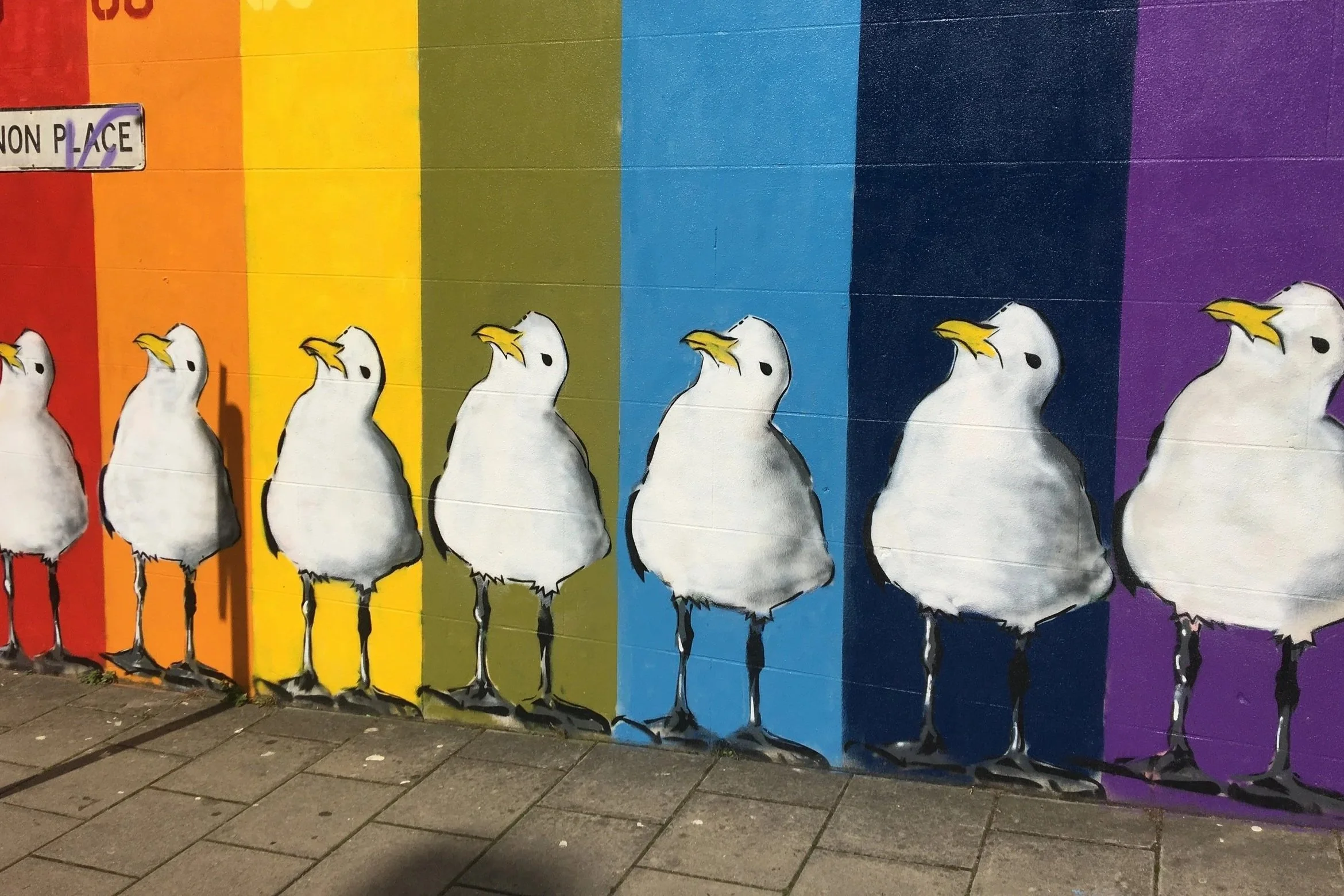
This guide tells the story of LGBTQ+ Britain through the streets, buildings and public spaces of Brighton & Hove. Each short chapter explores a turning point in national LGBTQ+ history, how Brighton both reflected and shaped those wider changes, and the places that bring that story to life.
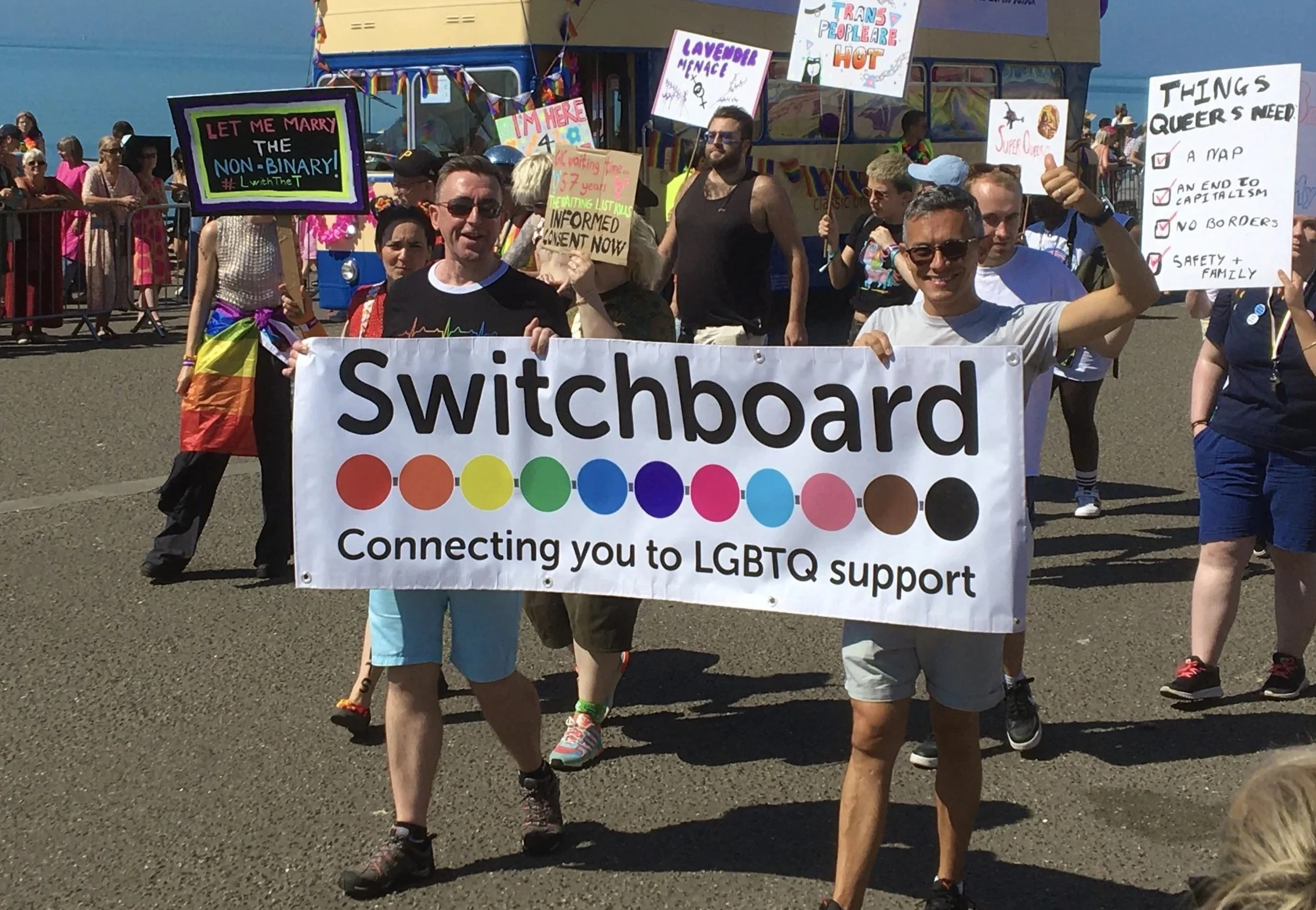
If you enjoy this guide and would like to support LGBTQ+ equality in Brighton, please consider making a donation of £3, or whatever you can, to Brighton & Hove LGBT Switchboard.
This guide is intended as an accessible introduction, rather than an academic work. It draws on the published sources listed at the end of the guide, together with my own knowledge and research. If you spot an error or have a suggestion for improvement, I’d be delighted to hear from you via the Contact page.
1. Criminalisation and Hidden Lives (c. 1750–1885)
For centuries, sexual relations between men were criminalised in Britain. Until 1861, they could be punished by death; the last executions took place in 1835. LGBTQ+ people existed in every part of society but generally lived hidden lives.
Brighton’s importance in LGBTQ+ history was probably no accident. As a town increasingly built around visitors, it offered a level of freedom and reinvention that likely attracted people who felt constrained elsewhere. The constant flow of soldiers, visitors and seasonal residents created a degree of anonymity.
Brighton’s transformation began in the mid-eighteenth century when physician Dr Richard Russell popularised sea bathing and the drinking of seawater as treatments for various illnesses. Visitors flocked to the town, and the arrival of the Prince Regent, whose seaside residence became the Royal Pavilion, accelerated its growth into one of Britain’s most fashionable resorts. At the same time, Brighton was a garrison town during the wars with Revolutionary and Napoleonic France.
One of the earliest recorded references to same-sex attraction in Brighton comes from 1822, when a servant named George Wilson was accused of propositioning a guardsman he had met in a Pool Valley pub.
Brighton attracted individuals whose lives challenged conventional expectations. In 1826, Anne Lister, often described as “the first modern lesbian”, spent several days in Brighton with her lover Marianna Lawton while waiting for a boat to France. During their stay they promenaded along the Chain Pier (destroyed during a storm in 1896) and explored the fashionable Regency town.
Where History Happened: The Royal Albion Hotel, 35 Old Steine
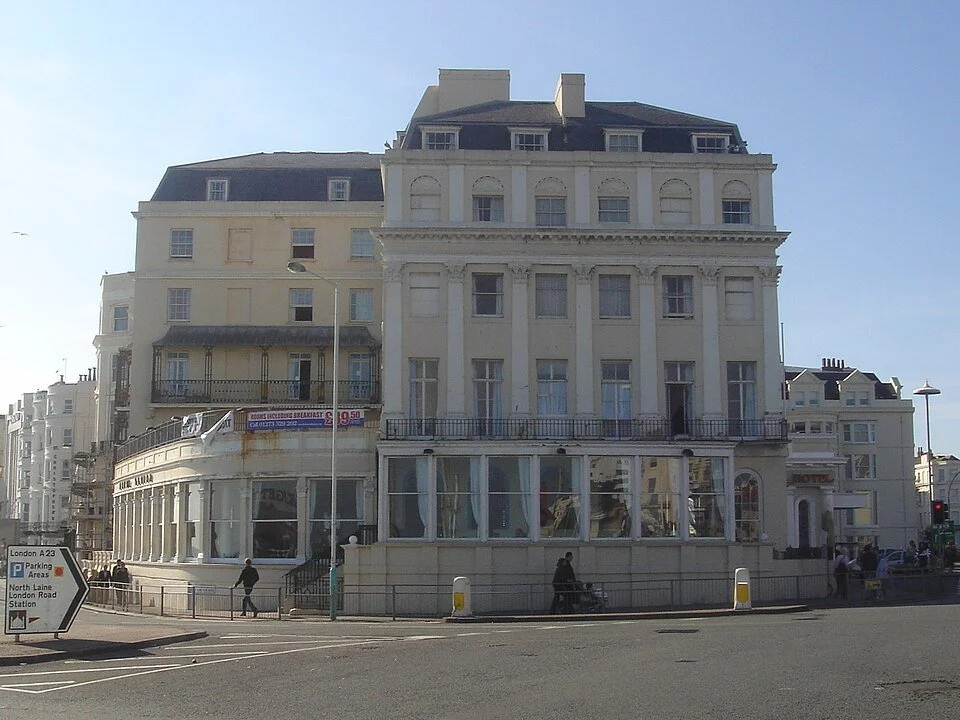
Opened in 1826, the Royal Albion Hotel stands at the heart of Brighton’s LGBTQ+ story. Designed by Regency architect A. H. Wilds and built on the former site of Dr Richard Russell’s home, the hotel connects several sections of this guide.
Philanthropist Angela Burdett-Coutts, one of the wealthiest women in Victorian Britain, regularly stayed here with her lifelong companion Hannah. The pair were widely recognised as devoted companions and spent part of each year together at the hotel.
In 1894, Oscar Wilde stayed here with Worthing newspaper seller Alfonso Conway, a liaison that would prove fateful. The encounter later formed part of the evidence gathered against Wilde for his trial for gross indecency.
In the twentieth century, the Royal Albion became a gathering place for Brighton’s emerging LGBTQ+ community. It hosted women-only tea dances, meetings of the Gay Liberation Front in the early 1970s, and the tea dance that followed Brighton’s first Gay Pride march in 1973.
Although badly damaged by fire in 2023, the Grade II listed eastern wing survives and plans are underway for its restoration.
2. Victorian Repression (1885–1914)
The Criminal Law Amendment Act 1885 introduced the offence of “gross indecency” between men, expanding the scope for prosecutions. Fear, secrecy and blackmail shaped many gay lives. The prosecution and conviction of Oscar Wilde became a symbol of the risks faced by gay men.
Brighton was connected to this story. In 1884, Wilde gave a series of lectures at the Royal Pavilion as part of his UK lecture tour. A decade later, at the height of his fame, he returned to Brighton and the Sussex coast. In 1894, he stayed at the Royal Albion Hotel with Alfonso Conway, a Worthing newspaper seller. Six months later, private detectives employed by the Marquess of Queensberry, father of Wilde’s lover Lord Alfred Douglas (“Bosie”), tracked Conway down as part of the campaign against Wilde.
Wilde and Bosie also spent time together in Brighton, staying at the Metropole Hotel and renting rooms on King’s Road. This was while Wilde was living nearby in Worthing, where he wrote The Importance of Being Earnest. After Queensberry publicly accused Wilde of “posing as a sodomite”, Wilde brought a criminal libel case against him. The case collapsed, Wilde was arrested for gross indecency, and in 1895 he was sentenced to two years’ hard labour. His downfall shocked Victorian society and remains one of the defining moments in British LGBTQ+ history.
A blue plaque at St Ann's Court, Nizells Avenue, Hove, marks the final home of Bosie. His poem Two Loves (1894) included the phrase “the love that dare not speak its name", which became famous during Wilde's trial. Although Bosie later turned against Wilde and publicly criticised him, he eventually softened his views, writing in 1935 of his enduring devotion to the memory of “this brilliant and wonderful man".
A blue plaque at 12 Buckingham Road, Brighton, commemorates Aubrey Beardsley, the Brighton-born Art Nouveau illustrator known as “the master of line”. A friend and collaborator of Wilde, Beardsley illustrated Wilde’s play Salome and became the first art editor of The Yellow Book, an influential literary and artistic quarterly publication. Following Wilde’s prosecution, Beardsley was swept up in the scandal and dismissed from this role despite no involvement in the case. His work frequently explored themes of eroticism, same-sex attraction and gender ambiguity. He died from tuberculosis at the age of just 25.
There were also more hopeful stories in this period. Harriet Elphinstone-Dick, born in Brighton in 1852, challenged Victorian expectations of women through her record-breaking swimming feats. She later emigrated to Australia with her companion Alice Moon, where the pair established Melbourne’s first gymnasium for women.
Victorian Brighton & Hove was also the birthplace of Edward Carpenter, whose writings helped lay the foundations of the modern LGBTQ+ rights movement.
Where History Happened: Edward Carpenter’s Childhood Home, 45 Brunswick Square
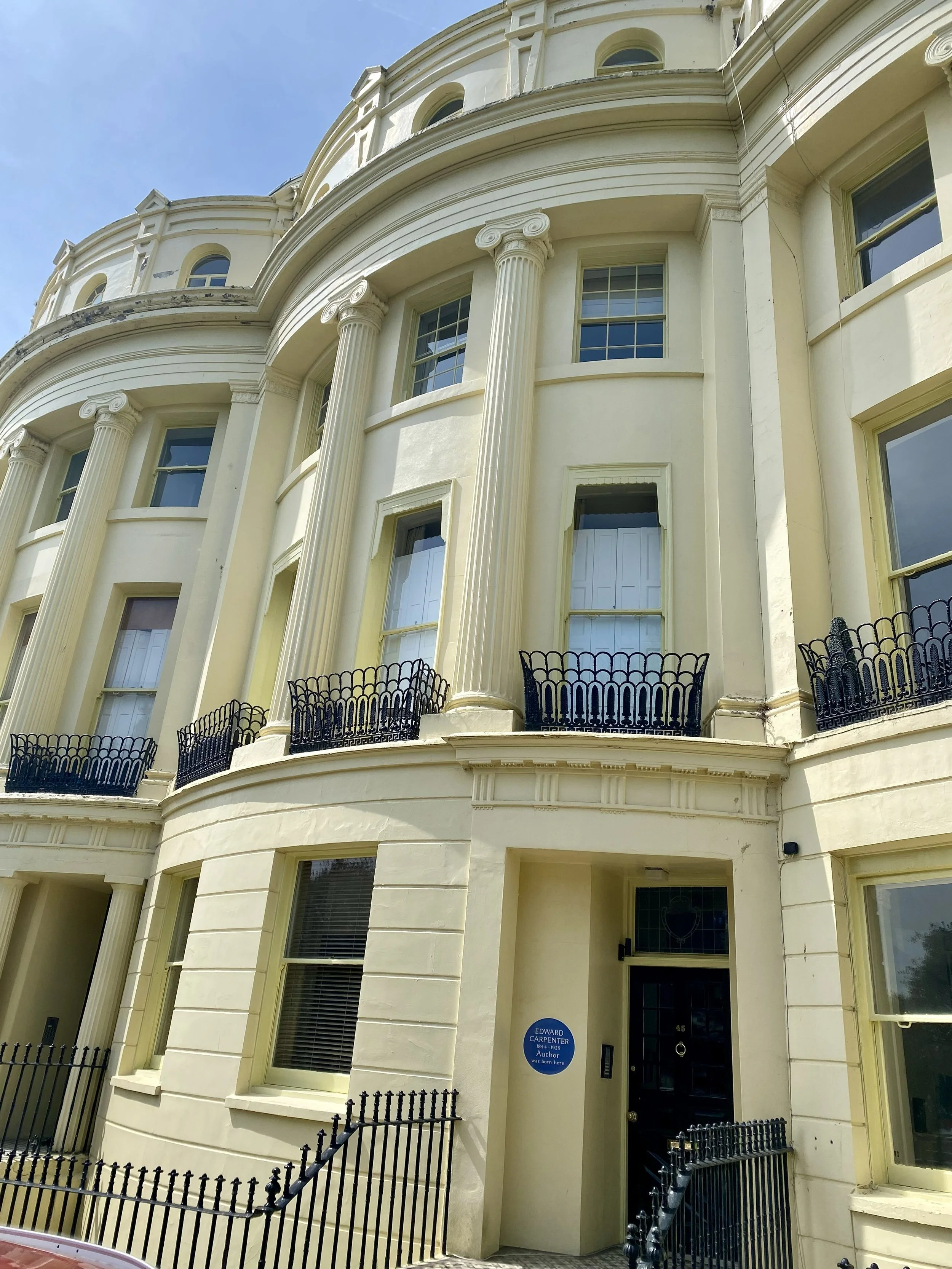
Born at 45 Brunswick Square, Hove, in 1844, Edward Carpenter has been described by human rights activist Peter Tatchell as “arguably the true pioneer of the LGBTQ+ rights movement in England”. Educated at Brighton College, Carpenter became a socialist, poet, philosopher and one of the earliest advocates for gay law reform.
At a time when homosexuality was a criminal offence, Carpenter lived openly with his long-term partner George Merrill from the 1890s onwards. This was courageous in an era when same-sex relationships could lead to imprisonment and social ruin. Through works such as Homogenic Love and Its Place in a Free Society (1894) and The Intermediate Sex (1908), he argued that same-sex love was natural and should be accepted rather than condemned.
Several of Carpenter’s ideas were far ahead of their time, anticipating not only the sexual revolution of the 1960s, but also later environmental and animal rights movements.
3. War and Social Change (1914–1945)
The First and Second World Wars disrupted traditional social structures across Britain. Military service, wartime mobilisation, and movement around the country enabled many LGBTQ+ people to encounter others like themselves for the first time. Informal communities grew despite continuing criminalisation.
As a military garrison, coastal and tourist town, Brighton experienced dramatic social change during both wars. The movement of troops, workers and visitors helped create new social networks, contributing to Brighton’s growing reputation as a place where some LGBTQ+ people could live with greater freedom than elsewhere.
By the 1930s, Brighton was becoming established as a destination for gay men and lesbians. Playwright Noël Coward, himself gay, is said to have described the town as “Ah, dear Brighton – piers, queers and racketeers.”
Pubs with lesbian and gay patrons flourished, including Pigott’s Bar at the St James’s Tavern in Madeira Place - one of the earliest Brighton pubs associated with a predominantly lesbian clientele - and the Star of Brunswick in Hove.
Where History Happened: The Star of Brunswick, 1–3 Brunswick Street West
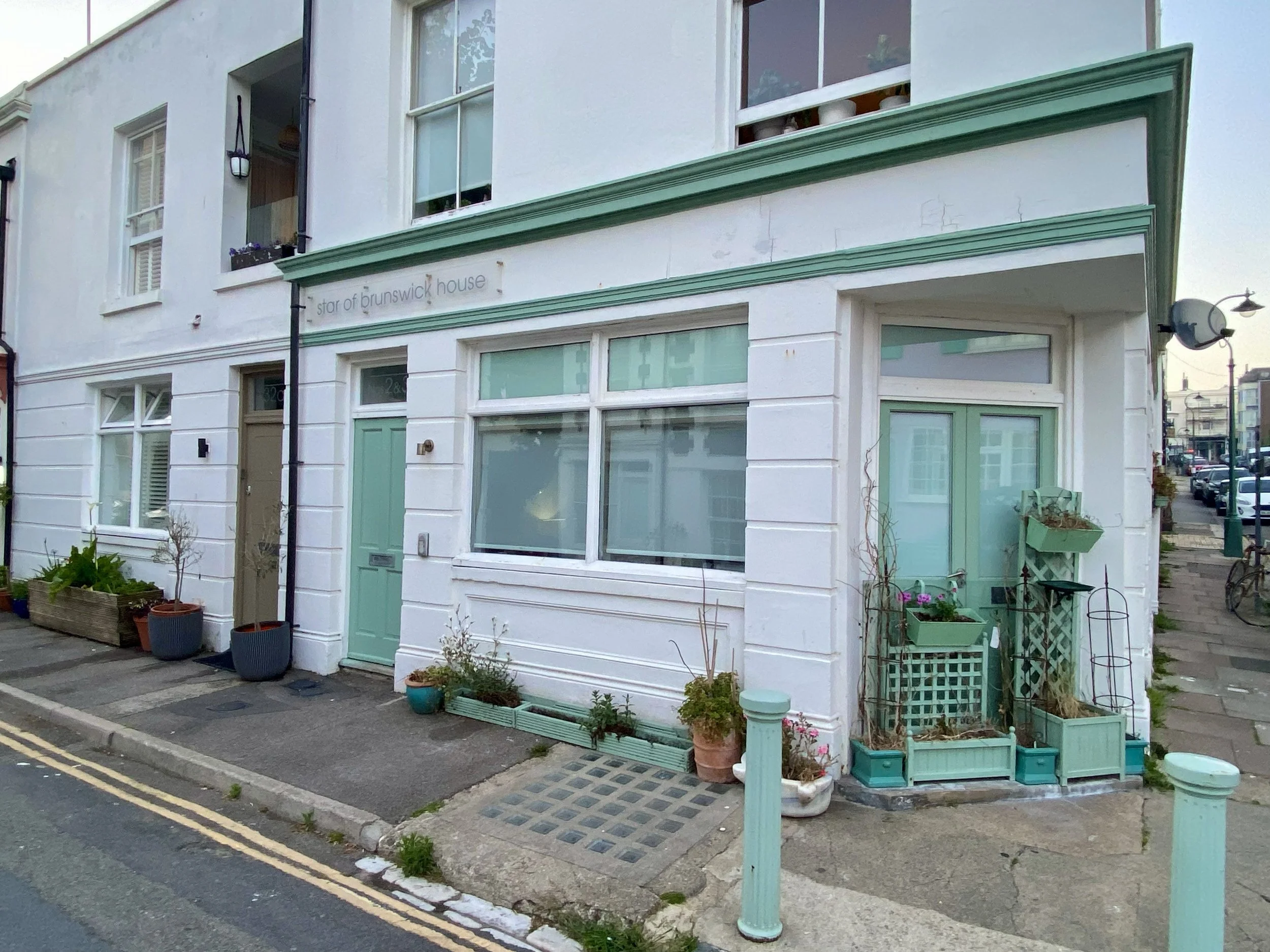
Built in the 1820s to a design by architect Charles Busby, a key figure in the development of Brighton & Hove, the Star of Brunswick stands at 1–3 Brunswick Street West, Hove. While evidence from this period is fragmentary, local histories suggest that by the 1920s and 1930s the pub had become a popular meeting place for members of the gay community.
Playwright and local historian John Montgomery later recalled: “From London in the thirties we used to roar down to Brighton in fast sports cars… The main rendezvous was the Star of Brunswick pub in Hove.” He remembered a Brighton of lively pubs, visiting guardsmen and sailors, and a flourishing social scene.
Although the pub closed in 2005 and was converted into housing, its exterior remains largely unchanged. And the original pub’s name has been subsumed into the building’s new name.
The area remains welcoming and LGBTQ+ friendly. Just up the street is the Bow Street Runner, while nearby on Brunswick Street East, on the other side of Brunswick Square, is Bottom’s Rest. Both are excellent places to stop for a drink and reflect on the history of the neighbourhood.
4. Wolfenden and Reform (1945–1967)
In the post-war period, most gay men continued to hide their identities. Sexual relations between men remained criminalised and prosecutions were common. The publication of the Wolfenden Report in 1957 marked a turning point. It argued that consensual sexual behaviour between adults in private should not be a matter for criminal law. Although reform was still years away, public debate had begun.
Brighton was already becoming one of Britain’s leading gay destinations. Until cheap package holidays transformed tourism in the late 1960s, it was the premier holiday resort for many gay men and lesbians. Word spread about guesthouses where proprietors turned a blind eye to illegal “goings-on”, or quietly welcomed LGBTQ+ guests. Among the best known were the St Albans Hotel in Regency Square, the Cecil Court Hotel on King’s Road, and Le Chateau Gaye in Castle Street.
Other venues ranged from the lavish Regina Club in North Street and the exclusive Argyle Hotel in Middle Street, to the Belvedere and Fortune of War pubs on the seafront, and the Spotted Dog (now the Hop Poles) on Middle Street. By the 1950s and 1960s, Brighton had a flourishing LGBTQ+ scene.
Yet there were good reasons for avoiding gay bars and clubs. Police regularly raided known venues, taking names and addresses. Many people used “club names” to protect their identities. If word reached employers, landlords or family members, the consequences could be devastating.
Where History Happened: The Aquarium, Marine Parade
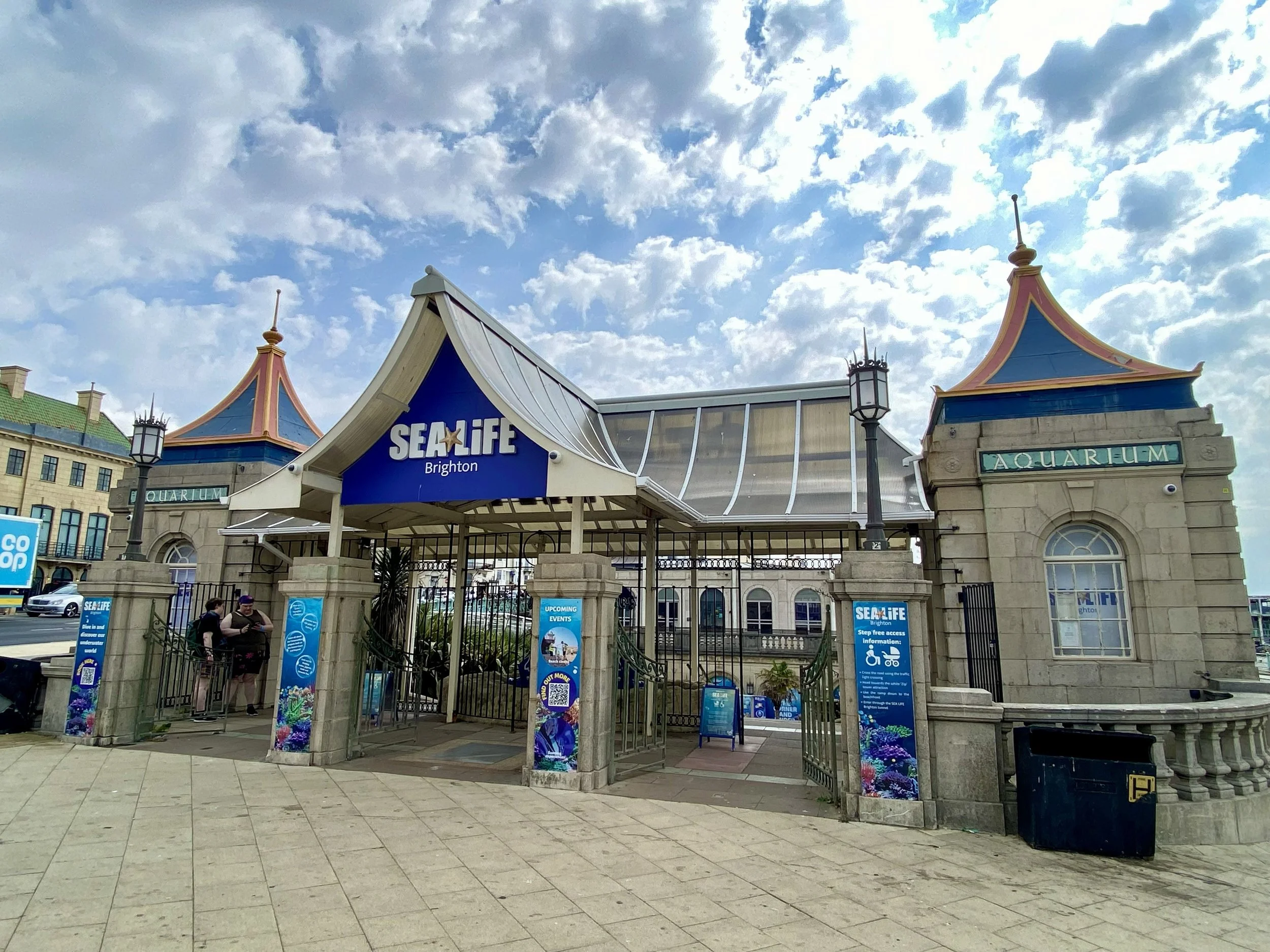
The highlight of the social calendar for some lesbians and gay men in the austere years after the Second World War was the Sussex Arts Ball, held in the ballroom of the Aquarium, now the Brighton Sea Life Centre.
Started in 1947 as a celebration of local arts and business, it soon became famous for its carnival atmosphere and attracted lesbians, gay men, drag performers and others from across Sussex and beyond. Among its stars was the drag performer Betty Lou, who regularly stole the show.
For a few nights each year, the Aquarium offered something increasingly rare in post-war Britain: a place where people could relax, dress up and express themselves more freely.
5. Decriminalisation, Community and Liberation (1967–1970s)
The Sexual Offences Act 1967 partially decriminalised sex between men in England and Wales. However, many restrictions remained and discrimination was widespread. For most gay people, legal reform did not immediately translate into social acceptance.
Nevertheless, change was underway. Increasing numbers of LGBTQ+ people chose to live more openly, and Brighton continued to attract people from across Britain seeking greater freedom and community. By the 1970s, the city was becoming one of the UK’s most important LGBTQ+ centres.
New community spaces emerged. The Forty-Two Club at 42 King’s Road, Brighton’s longest-running gay club, became a focal point for social life and hosted a series of camp theatrical reviews with titles such as Brighton Gay, Brighton Gayer and Brighton Gayest. The Curtain Club, located underneath the Queens Hotel, was one of Brighton’s best known gay and mixed clubs in the 1970s, while The Bulldog, which opened in 1979 on St James’s Street, and is still going, went on to become one of the UK’s longest-running gay bars.
Bookshops also played an important role. Unicorn Bookshop at 50 Gloucester Road, owned by openly gay poet and writer Bill Butler, provided a welcoming space where people could meet and discover books and ideas that were unavailable elsewhere.
Sillwood Street reflected the diversity and vibrancy of the period. The Starlight Rooms hosted early performances by David Bowie, while nearby venues included the Rockingham (now the Lion & Lobster pub) and, later, the Caves Club, which likely replaced a Persian coffee bar and club created by knocking through into the basement of the neighbouring newsagent (owned by my grandmother). Just around the corner, at 5 Norfolk Buildings, the south coast branch of the Minorities Research Group met. Founded in 1963, it was Britain’s first lesbian social and discussion network and publisher of Arena Three, the country’s first available openly lesbian magazine.
The decade also saw the emergence of a more confident and visible LGBTQ+ movement. In 1971, students at the University of Sussex established the Sussex Gay Liberation Front, inspired by the radical movement that had emerged after the Stonewall riots in New York. The group organised Brighton’s first gay rights demonstration in 1972. The Campaign for Homosexual Equality and Brighton Lesbian Group also became important spaces for campaigning, discussion and community building.
Support networks developed too. In 1975, the Brighton Lavender Line, now Brighton & Hove LGBT Switchboard, began operating from the Open Café in Victoria Road. What started as a single telephone in a back room would grow into one of the UK’s oldest LGBTQ+ support organisations.
Where History Happened: Norfolk Square
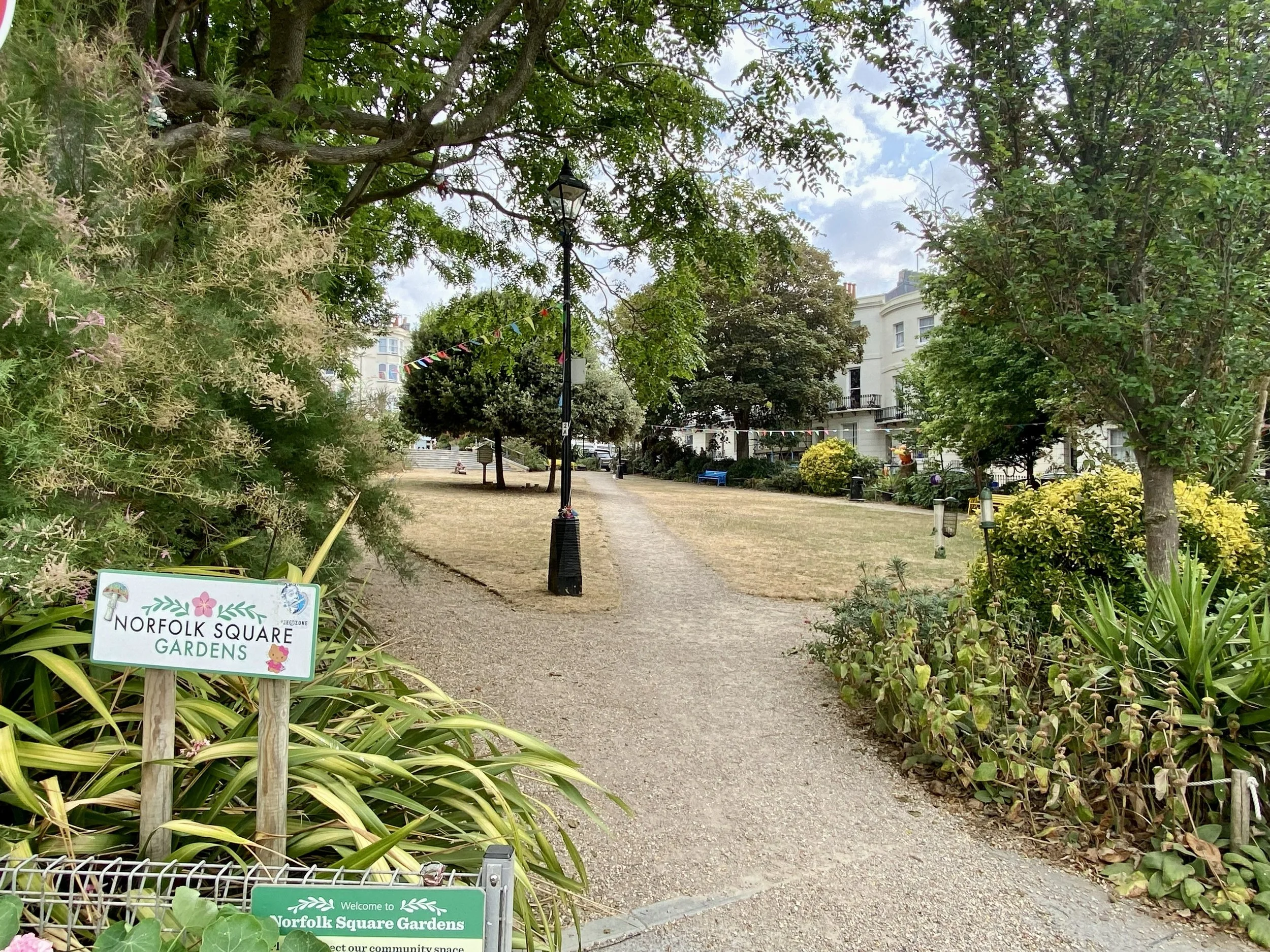
The modern story of LGBTQ+ Brighton arguably began in Norfolk Square. In July 1973, the Sussex Gay Liberation Front launched Brighton’s first Gay Pride Week, combining protest with celebration. The programme included one of Britain’s earliest symbolic public same-sex weddings, between John Roman Baker and Graham Wilkinson, later co-founder of the Sussex AIDS Helpline.
On Saturday 7 July, the Pride march set off from Norfolk Square before heading along the seafront to the Old Ship Hotel on King’s Road. Around 200 people later attended a dance at the Royal Albion Hotel, linking the event to a building that has already appeared in this guide. The weekend concluded with a picnic on the beach opposite today’s Queens Hotel.
The march would be Brighton’s last Pride march for many years. Nevertheless, just six years after partial decriminalisation, LGBTQ+ people were beginning to step out of the shadows and claim their place in public life.
Today, nearby Western Street is home to two long-established, welcoming LGBTQ+ pubs: the Bedford Tavern and the Grosvenor Bar.
6. HIV/AIDS: Loss and Resilience (1981–1998)
After a decade of growing visibility and liberation, the HIV/AIDS epidemic devastated LGBTQ+ communities across Britain. Thousands died, while fear, stigma and discrimination spread rapidly. At the same time, the crisis inspired extraordinary acts of compassion, activism and mutual support.
Brighton was one of the UK cities most affected by HIV/AIDS. With Kemp Town, Brighton’s vibrant eastern neighbourhood, now established as the heart of the city’s LGBTQ+ community, almost everyone knew someone living with HIV or someone who had died. Healthcare professionals, charities, volunteers and community organisations responded with remarkable determination.
Brighton Gay Switchboard (now Brighton & Hove LGBT Switchboard) was one of the first organisations in the country to respond, producing an information leaflet in 1983 to combat widespread misinformation. In 1984, the Sussex AIDS Helpline was established, later expanding to provide volunteer home care for people living with HIV. Campaigners challenged the tabloid myth of the “gay plague” while also encouraging safer sex within the community. In 1989, the AIDS Positive Underground Theatre Company was founded in Brighton, using theatre to explore the impact of HIV/AIDS and challenge prejudice.
The Sussex Beacon became one of Brighton’s most enduring legacies of the AIDS epidemic. Established in 1992 through a community fundraising effort, the charity responded to an urgent need for specialist care and support for people living with HIV. Its purpose-built centre opened in 1994 on Bevendean Road, providing residential, nursing and end-of-life care at a time when there were no effective combination treatments for HIV. As HIV became a manageable long-term condition for many people, the Beacon evolved too, expanding into rehabilitation, mental health, peer support and community services. More than thirty years later, it remains a much-loved part of Brighton’s LGBTQ+ community and one of the UK’s leading specialist HIV organisations.
Where History Happened: The AIDS Memorial, New Steine Gardens
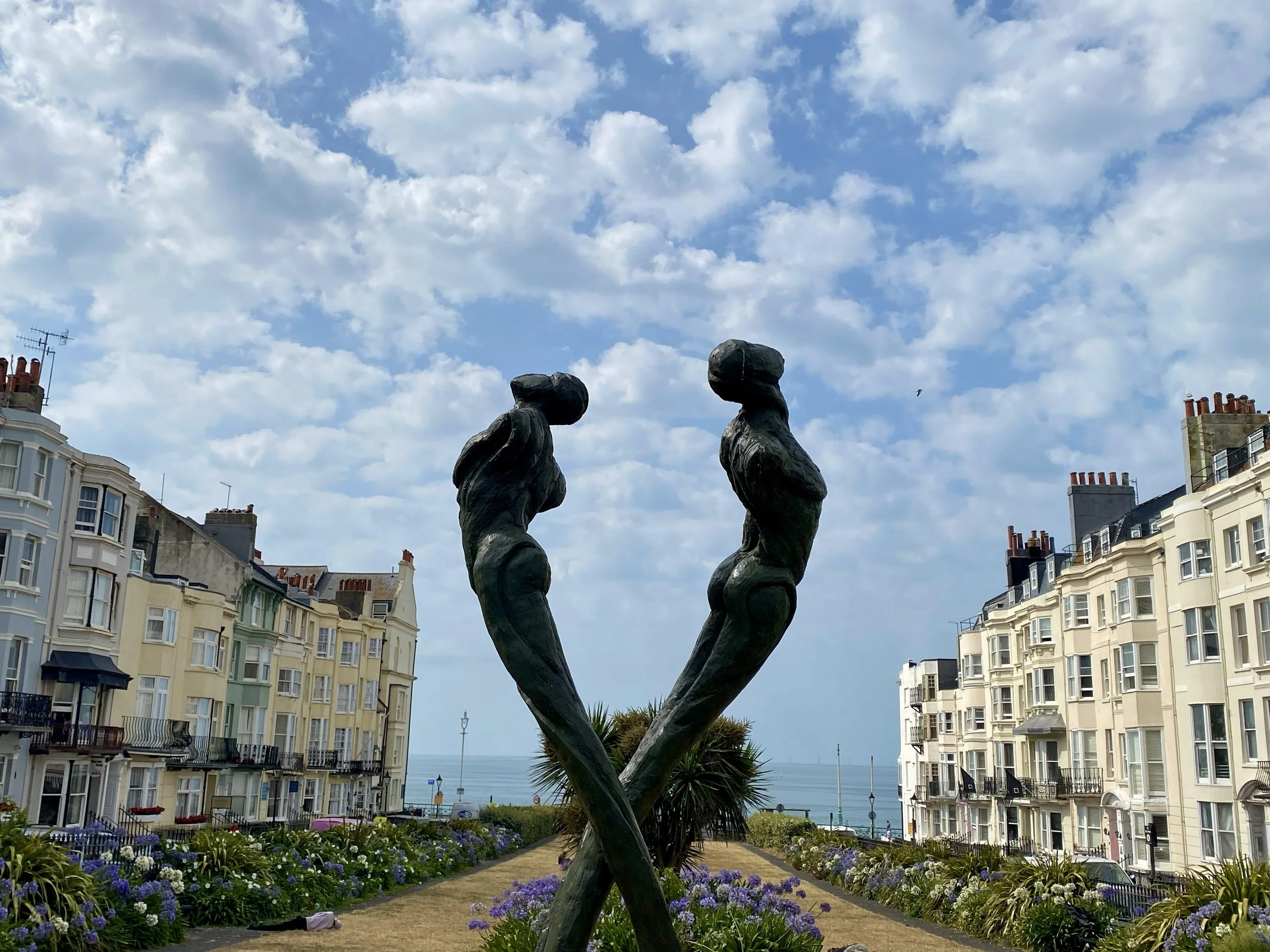
Standing in the heart of Kemp Town, the Brighton AIDS Memorial is one of the UK’s most moving public memorials to those lost to HIV/AIDS. Created by Brighton artist Romany Mark Bruce and unveiled in 2009, the four-metre bronze sculpture depicts two intertwined figures rising towards the sky. Their shadow forms the shape of the red ribbon, the international symbol of HIV/AIDS awareness.
The memorial was commissioned following a campaign led by GScene editor James Ledward and funded almost entirely through public donations. So much money was raised that Bruce was able to create a much larger sculpture than originally planned.
Bruce dedicated the work to his close friend Paul Tay, who died of AIDS in 1992. Reflecting on the memorial, he said: “When my best friend and soulmate Paul Tay died in 1992, the stigma of AIDS meant I felt unable to share the cause of his death. It was a lonely place to be, and my greatest fear was that I might forget him. Winning the commission turned out to be much more than an incredible opportunity to create a public sculpture. I feel enormously privileged, not only to have been able to remember Paul in a sculpture, but also to provide a public space where we can all grieve our losses.”
Today, the memorial remains a place of remembrance and solidarity. People gather here each year for World AIDS Day commemorations, memorial services and community vigils, including following the 2016 mass shooting at Pulse nightclub in Orlando, USA.
Kemp Town remains the heart of Brighton’s LGBTQ+ community. Nearby, Brighton Rocks on Rock Place is a great spot for cocktails, the Camelford Arms on Camelford Street is known for its excellent Sunday roasts, and The Bulldog on St James’s Street is one of the UK’s longest-running gay bars.
7. Section 28 and Activism (1988–2003)
While the HIV/AIDS epidemic was still devastating LGBTQ+ communities, a new political battle was beginning. Introduced by Margaret Thatcher’s Conservative government, Section 28 became law on 24 May 1988. It prohibited local authorities from “promoting homosexuality” or teaching “the acceptability of homosexuality as a pretended family relationship”. It had a profound cultural impact, particularly in schools, and became a rallying point for a new generation of LGBTQ+ activists.
Brighton quickly became a centre of opposition. Brighton Area Action Against Section 28 (BAAAS28) was formed in 1988 following a meeting of Brighton Lesbian Action. Each May from 1988 to 1991, campaigners marched from Hove Town Hall to Brighton Town Hall in protest. These demonstrations evolved into Brighton Pride Weekend in 1991, concluding with a picnic in Preston Park. The campaign continued until 1994 under its new name, OUTrights!
Calls for equality also took increasingly direct forms. In 1990, five lesbian activists stormed the stage of the International Congress of the Family at the Brighton Centre, unfurling banners reading “Lesbian and Gay Rights Now” shortly after an address by Diana, Princess of Wales. Later that day, Princess Diana visited people living with HIV at the Sussex AIDS Centre in Kemp Town.
The 1990s also saw Brighton’s LGBTQ+ nightlife flourish. Club Shame at the Zap Club, followed by Wild Fruit from 1992, attracted clubbers from across the South East. Revenge, Brighton’s first large dedicated gay nightclub, opened on the Old Steine in 1991 and became an institution of the city’s nightlife. New venues clustered around St James’s Street, cementing the area as Brighton’s Gay Village. In 2000, Brighton welcomed its first permanent venue dedicated to lesbians, Candy Bar on St James’s Street.
The community also found a strong public voice. G-Scene, Brighton’s first free LGBTQ+ magazine, launched in 1993. Funded largely by advertisements from the city’s LGBTQ+ pubs and clubs, it combined listings with campaigning journalism and helped chronicle Brighton’s rapidly changing LGBTQ+ community. Long-time editor James Ledward later spearheaded the campaign for Brighton’s AIDS Memorial, described above, and is commemorated through the Ledward LGBTQ+ Centre on Jubilee Street.
Where History Happened: Preston Park, Preston Road

Preston Park is Brighton & Hove’s largest urban park and one of the city’s best-loved green spaces. The first Brighton Pride Weekend in 1991 concluded here with a community picnic, and since 1996 it has been home to Brighton & Hove Pride’s main festival.
Pride continued to evolve alongside the community. In 2002, Brighton & Hove Pride explicitly recognised and celebrated the trans community, marking another important step towards a more inclusive festival.
Today, Preston Park hosts one of Europe’s largest Pride celebrations. From its beginnings as a community picnic, Brighton & Hove Pride has grown into an internationally recognised festival, attracting world-famous performers including the Pet Shop Boys, Britney Spears, Kylie Minogue, Mariah Carey and, in 2026, Diana Ross.
8. Equality and Visibility (1997–2015)
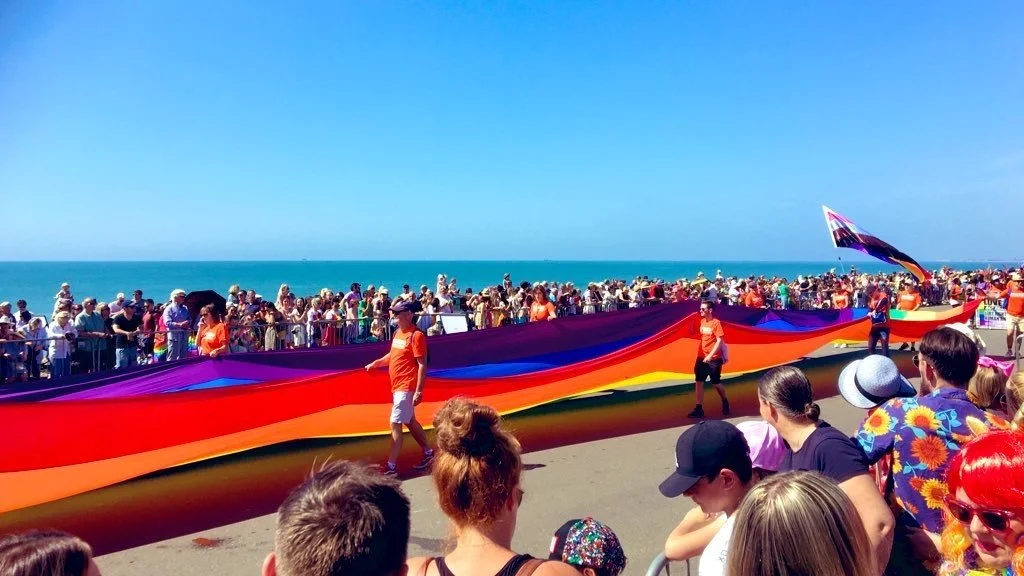
The election of Tony Blair’s Labour government in 1997 ushered in one of the most significant periods of LGBTQ+ legal reform in British history. Over the next two decades, LGBTQ+ people gained the right to serve openly in the armed forces, the age of consent was equalised, Section 28 was repealed, same-sex couples gained the right to adopt children, discrimination in employment and in the provision of goods and services was outlawed, the Gender Recognition Act 2004 enabled transgender people to legally change their gender, civil partnerships were introduced in 2005, and same-sex marriage became legal in England and Wales in 2014. Within a generation, the legal landscape had been transformed.
Brighton was widely recognised as Britain’s LGBTQ+ capital and a symbol of growing visibility and acceptance. The city elected several openly gay MPs. In 2018, Russell-Moyle became the first MP to disclose in the House of Commons that he was living with HIV, using his speech to challenge stigma and encourage testing.
Pride continued to grow into one of Europe’s largest LGBTQ+ festivals, while increasing attention was given to the rights and visibility of transgender people. In 2013, Brighton hosted the first Trans Pride, the first and largest event of its kind outside the USA. For several years, the festival was held in Brunswick Square, overlooked by the former home of the pioneering LGBTQ+ rights thinker Edward Carpenter, introduced above, whose ideas challenged conventional Victorian attitudes towards sex and gender.
Where History Happened: Brighton Town Hall, Bartholomew Square

For generations, Brighton Town Hall has marked many of life’s most important moments. It has also witnessed the transformation of LGBTQ+ equality.
Following the introduction of civil partnerships, countless same-sex couples formalised their relationships at the Town Hall. Among the first were Debbie Gaston and Elaine Cook, who entered one of Brighton’s first civil partnerships on 21 December 2005. Less than a decade later, following the legalisation of same-sex marriage, Neil Allard and Andrew Wale became the first same-sex couple to marry in Brighton during a special midnight ceremony at the nearby Royal Pavilion on 29 March 2014.
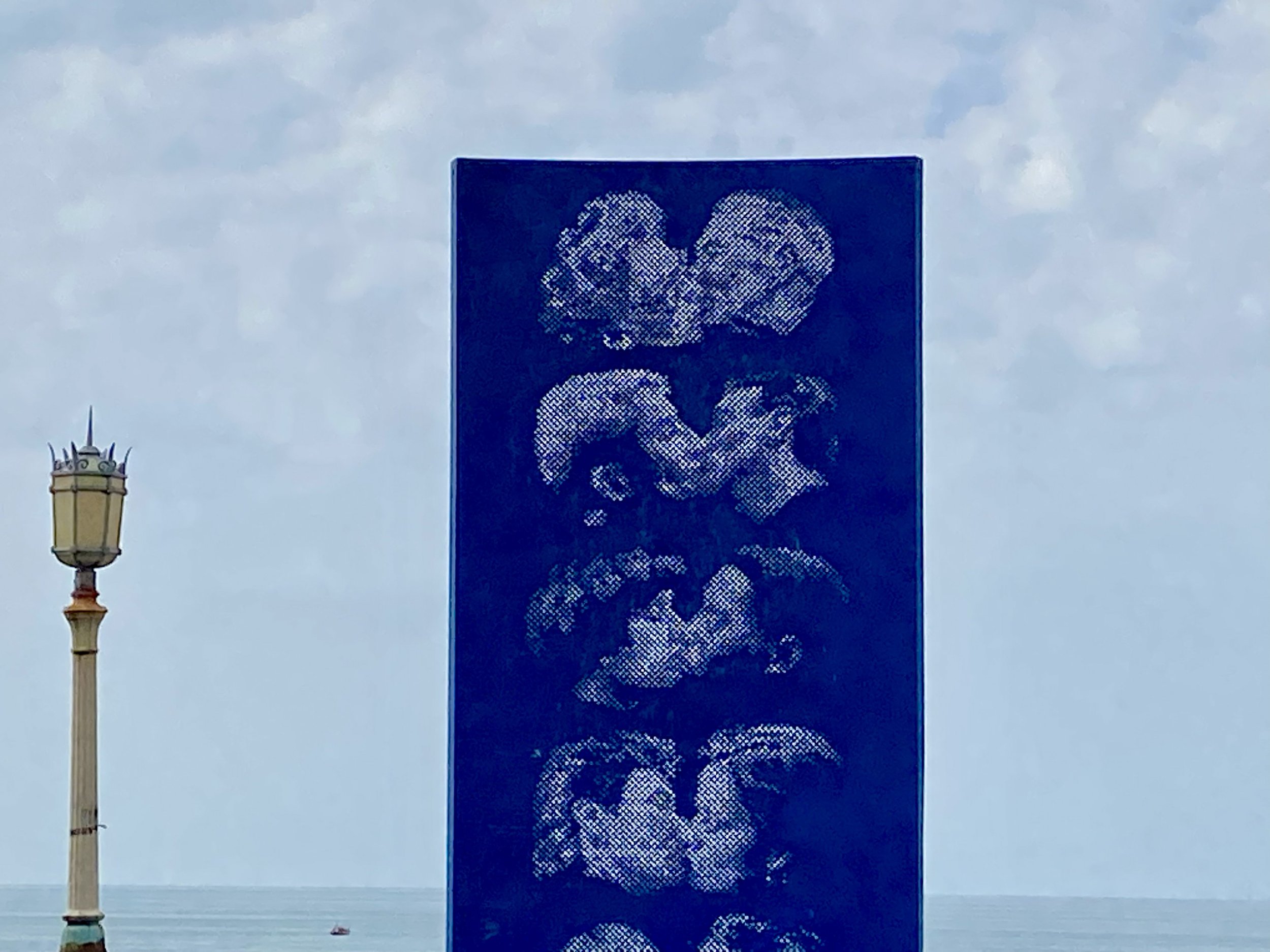
Just a short walk from the Town Hall stands Bruce Williams’ Kiss Wall, installed on the seafront in 1992. Featuring photographs of six kissing couples, all Brighton residents, it was the first public sculpture in Britain to depict a same-sex kiss. Installed long before full legal equality was achieved, it celebrated the diversity of Brighton’s community and made a statement that love in all its forms belonged proudly in the heart of the city.
9. Unfinished Business and Global Influence (2015–Present)
The story of LGBTQ+ equality is still being written. At the time of writing, in 2026, significant legal and social challenges remain. The Supreme Court’s interpretation of sex under the Equality Act, and subsequent guidance on its implementation, have created concern and uncertainty for transgender people. The government published a draft bill to prohibit abusive conversion practices in June 2026, but no comprehensive ban is yet in force. Meanwhile, the UK has fallen sharply down ILGA-Europe’s Rainbow Map after ranking first in Europe as recently as 2015.
Brighton continues to play an important role in shaping the future of LGBTQ+ equality. Local organisations campaign for change, support LGBTQ+ people and contribute to national advocacy, while Brighton & Hove Pride and Trans Pride provide visible platforms for solidarity and action.
Brighton’s influence extends beyond the city itself. Brighton & Hove Pride has become one of Europe’s largest and best-known Pride festivals, regularly drawing attention to LGBTQ+ rights around the world. The city’s universities have also played an important role. The University of Sussex is home to the Centre for the Study of Sexual Dissidence and the Centre for Gender Studies, both with significant international reach, while the University of Brighton’s internationally recognised Centre for Transforming Sexuality and Gender conducts research on sexuality, gender and social change.
The city has also become a base and source of inspiration for organisations whose work reaches far beyond the UK. Brighton-based Frontline AIDS, formerly the International HIV/AIDS Alliance, supports community action on HIV, health and human rights around the world. The city also has connections to GiveOut, the international LGBTQ+ community foundation, and The Shameless Fund, which supports LGBTQ+ organisations in the UK and the USA.
Where History Happened: The Patcham Pylons
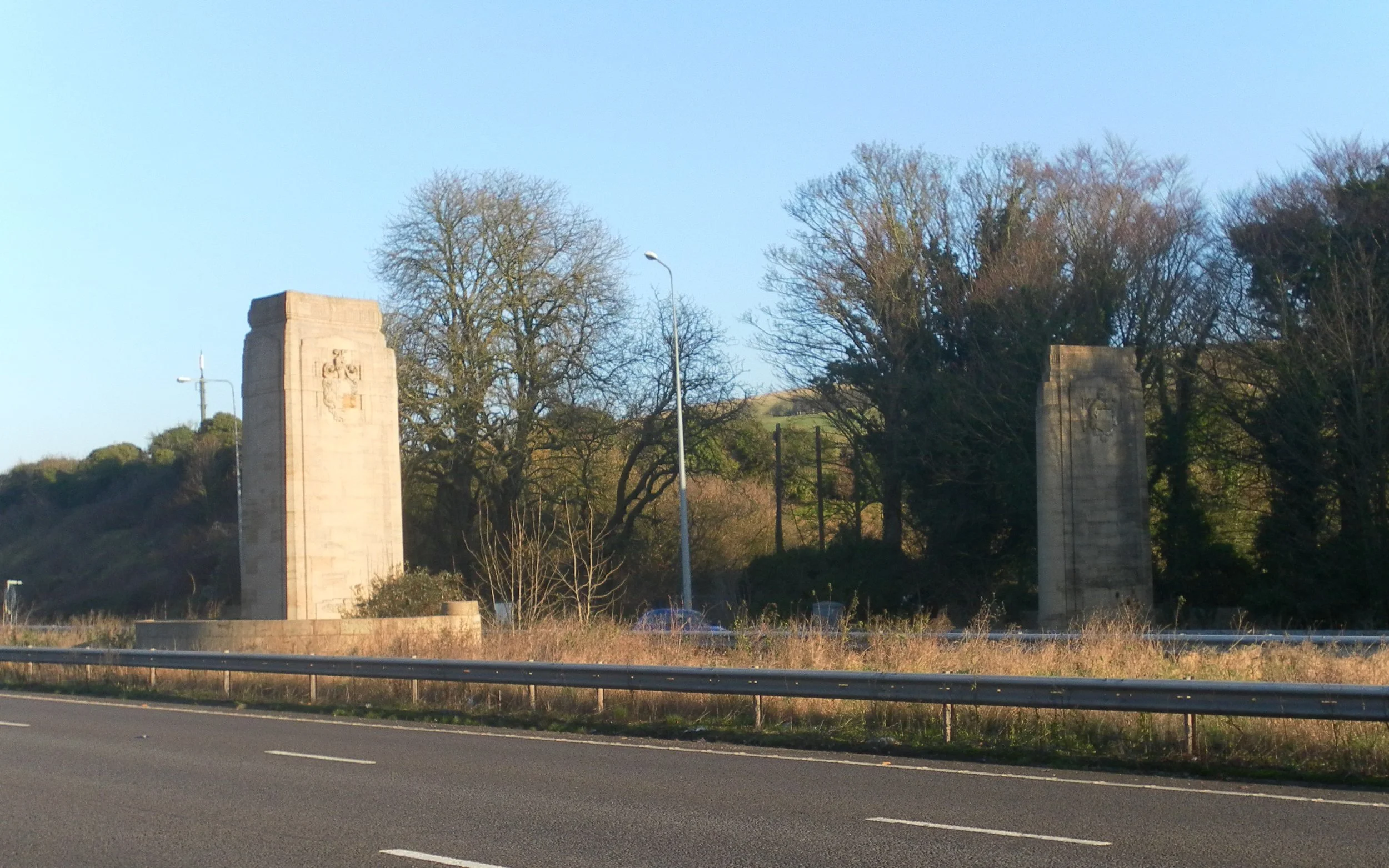
Standing at the northern road gateway to Brighton & Hove, the Patcham Pylons have welcomed visitors since 1928. Designed by the architect John Leopold Denman, they bear an inscription that seems remarkably fitting for Brighton’s story:
“Hail Guest. We ask not what thou art. If friend, we greet thee hand and heart. If stranger, such no longer be. If foe, our love shall conquer thee.”
For generations, LGBTQ+ people have come to Brighton seeking what they could not always find elsewhere: love, safety, friendship, community and the freedom to be themselves. Although the city has never been perfect, it has often been ahead of its time.
Today, Brighton is a place where LGBTQ+ history happened and a place that continues to influence LGBTQ+ history in Britain and beyond. The words on the Patcham Pylons remain both a welcome and a challenge: to build communities where everyone, whoever they are, belongs.
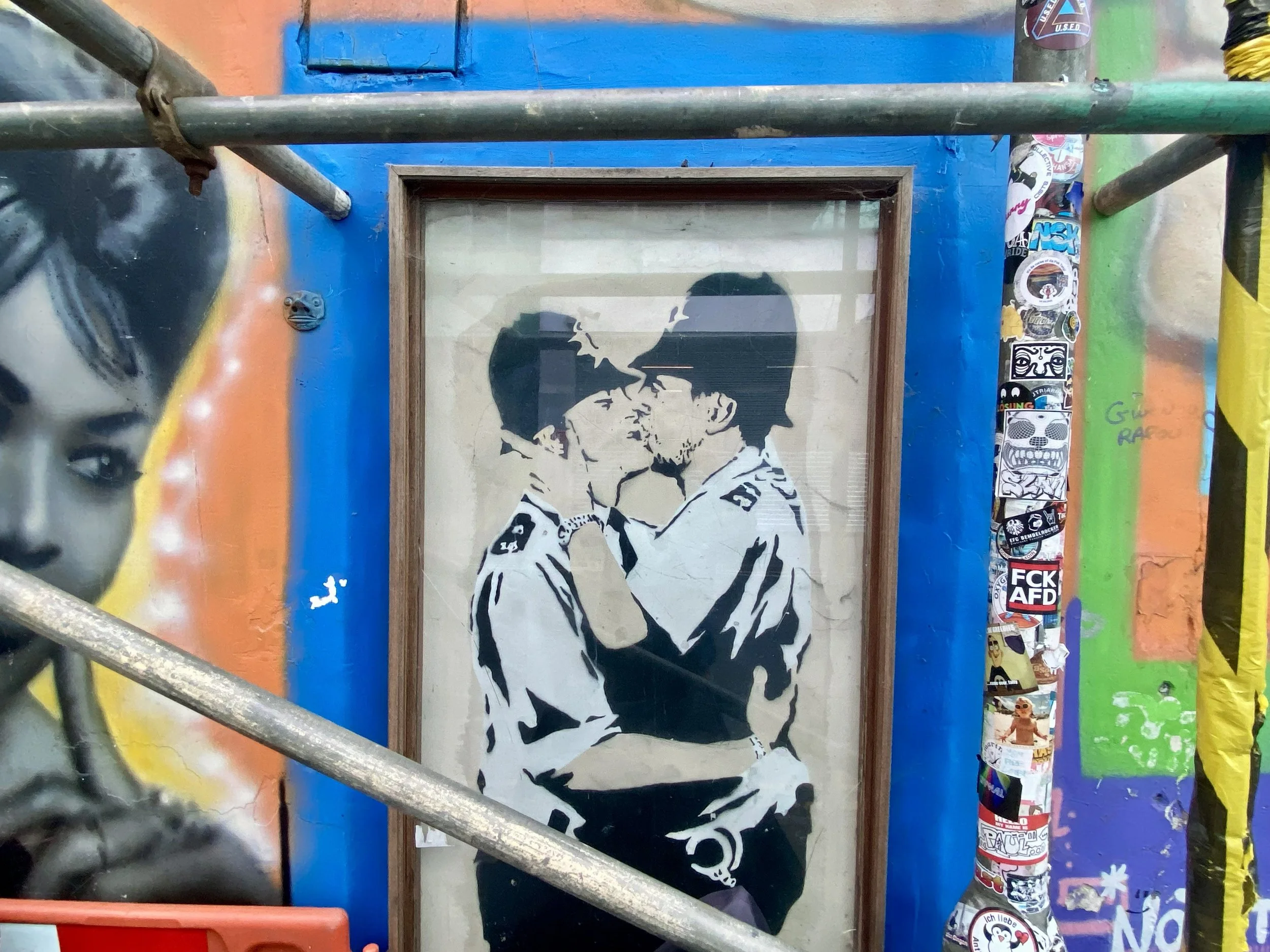
Finally, for those arriving in or leaving Brighton by train, look out for Banksy’s Kissing Coppers, first painted on the wall of the Prince Albert pub in 2004. Depicting two British policemen kissing, it became one of the artist’s most famous works and one of Brighton’s most recognisable images. The original was removed after repeated vandalism and later sold, but a faithful replica now occupies its place.
If you’d like to end your journey with a drink, the Brighton Tavern on Gloucester Road is a friendly and welcoming pub that hosts a lovely Pride celebration each summer. For the best coffee and an equally warm welcome, head to Dandy, the independent café on the corner of Sydney Street and Gloucester Street, run by musicians.
Selected Sources and Further Reading
This guide draws on books, archives, museums, oral histories, online resources and local knowledge. With thanks to the historians, researchers and volunteers whose work documenting and preserving Brighton's LGBTQ+ history made this guide possible.
Books
Brighton Ourstory Project. Daring Hearts: Lesbian and Gay Lives of 50s and 60s Brighton. QueenSpark Books, 1992.
Cameron, Janet. LGBT Brighton and Hove. Amberley Publishing, 2009.
Rowbotham, Sheila. Edward Carpenter: A Life of Liberty and Love. Verso, 2008.
Articles
Hinkins, Lisa. The Gay Capital of the UK: A Brief Queer Story of Brighton & Hove. Brighton & Hove Museums, 2024.
McIntosh, Anthony. Romany Mark Bruce's “Tay" (AIDS Memorial). Art UK, 2021.
Tatchell, Peter. Edward Carpenter: Socialist & LGBTQ+ Rights Pioneer (1844–1929). Peter Tatchell Foundation, 2020.
The Sussex Beacon. Our History.
Archives, Museums and Heritage
Brighton Ourstory Project – A History of Lesbian & Gay Brighton, oral histories and community archive.
Brighton & Hove Museums – exhibitions and online resources on the city's LGBTQ+ history.
Gay History – website by historian Alf Le Flohic exploring Brighton's LGBTQ+ history through articles, exhibitions and original research.
Queer Heritage South – digital archive, oral histories, heritage trail and mobile app.
My Brighton and Hove – local history articles on Brighton's buildings, communities and heritage
The Keep – Sussex's archive centre, home to a wide range of records relating to Brighton & Hove's history.
Guided Walks and Trails
Piers & Queers (Only in Brighton) – guided walking tour exploring Brighton's LGBTQ+ history.
Queer Heritage South: St James's Street Heritage Trail – self-guided walking trail exploring one of Brighton's historic LGBTQ+ neighbourhoods.
QueenSpark Books: Daring Hearts – Discover Brighton Trail – self-guided trail inspired by Daring Hearts, exploring places connected with Brighton's LGBTQ+ history.
Support LGBTQ+ equality in Brighton
If you enjoy this guide and would like to support LGBTQ+ equality in Brighton, please consider making a donation of £3, or whatever you can, to Brighton & Hove LGBT Switchboard.